









Did you know that with grain preparation the phytic acid in grains can be neutralized? Don't know what phytic acid is? Neither did I until health problems began! Let me explain 2 methods of proper grain preparation.
All grains look bad if you have been introduced to the GAPS diet.
That is not the case at all, if, you have a healthy gut. It is important to remember that GAPS is a temporary diet with the goal of encouraging "good" bacteria and healing the gut. Once intestinal healing has occurred, you can add grains to your diet. Properly prepared grains, that is!
Have you ever wondered why we change the way we do things? Usually changes occur for the sake of convenience, time saving and/or money making for larger companies trying to provide consistency of products.
The truth is, the old traditional ways actually had a purpose behind them and the new, more convenient modern methods may be harming our bodies!
Take, for example, grain preparation. As early as 1200 - 1500 BC the people in Guatemala soaked corn, a process called Nixtamalization. According to Wikipedia:
Nixtamalization typically refers to a process for the preparation of maize (corn), or other grain, in which the grain is soaked and cooked in an alkaline solution, usually limewater, and hulled. Maize subjected to the nixtamalization process has several benefits over unprocessed grain for food preparation: it is more easily ground; its nutritional value is increased; flavor and aroma are improved; and mycotoxins are reduced.
People soaked far more than corn throughout history. Soaking grain allows the grain to sprout. The vitamin and enzyme content of sprouted grains increases dramatically. Plus, the phytic acid and enzyme inhibitors neutralize.
Also known a germinating, people sprouted food for centuries. The Chinese sprouted beans for ocean voyages. Injera is a national dish in Ethiopia and Eritrea and according to Wikipedia is made by soaking teff flour in water and allowing it to ferment for several days before baking the large pancakes. Injera has a sourdough like taste which brings me to the soudough process. Did you know that before the 19th century and the identification of yeasts, all yeast-leavened breads were sourdough? According to Wikipedia:
The leavening process was not understood until the 19th century, when yeast was first identified. Since then, strains of Saccaromyces cerevisiae have been bred for their reliability and speed of leavening and sold as "baker's yeast". Baker's yeast was adopted for the simpicity and flexibility it introduced to bread making, obviating the lengthy cultivation of a sourdough starter.
Another point of interest is that due to modern farming techniques, grains no longer germinate as they once did in sheaves and stacks in the field.
Who cares, you might think. After all, it is easier not to soak or sprout grain, beans, legumes and just stay with the options provided for us by our local grocery store.
But, there are a couple of important reasons that we all should care:
1. Sprouted grains have more nutritional value than their unsprouted counterparts
The vitamin and enzyme content of grains increases with sprouting.
According to Wikipedia:
The metabolic activity of resting grains and seeds increases as soon as they are hydrated during soaking. Improvements in amino acid composition, B-group vitamins, sugars, protein and starch digestibilities, and decrease in phytates and protease inhibitors are the metabolic effects of the sprouting process.
2. Phytic acid is present in the bran of all grains and the hulls of seeds. Phytic acid inhibits absorption of minerals - especially calcium, copper, iron, magnesium and zinc - in the body. According to Wikipedia:
In-home food preparation techniques can reduce the phytic acid in all of these foods ... effective methods are soaking in an acid medium, lactic acid fermentation, and sprouting.
Proper preparation of grains neutralizes the phytic acid and makes the grain more easily digested plus increases its nutritional value!
Why then, don't we take the time to properly prepare our grains, seeds and legumes? For many of us, it is lack of knowledge.
I have ground my own whole wheat flour from the wheat-berries and baked my homemade whole wheat bread for years now. Did I sprout my wheat-berries? No.
Did I soak my flour? No.
Why? Because I had never heard of phytic acid. I had never heard about the nutritional value of the grain increasing so dramatically when sprouted. This may explain my "moderately-severe" osteoporosis diagnosis at age 48, before menopause!
If it is so important, we should all know how to do it! If you do not have the time to sprout and soak your own grains, you can also purchase them (from my affiliate -where to buy sprouted flour)!
There are 2 methods of grain preparation and both involve soaking in water:
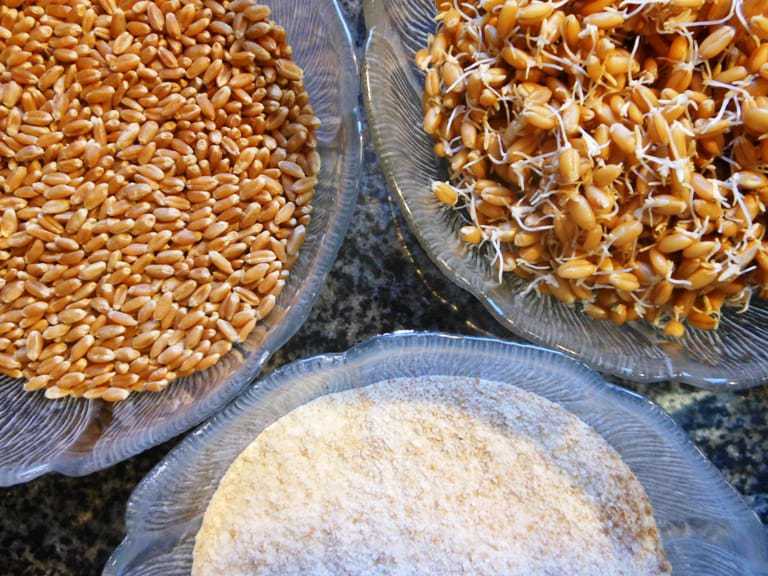
1. Sprouting
The basic method is the same for all grains, seeds, and legumes:
- Soak the grain (beans, seeds or nuts) in water overnight. A wide mouth mason jar with a mesh cover works well.
- In the morning, drain the water, rinse with fresh water and drain again.
- Tilt the jar so it will continue to drain while still allowing air circulation.
- Rinse the grain twice a day (morning and evening).
- When little sprouts appear and are ¼ inch long, the grain is ready to use.
- You can use this grain in recipes or place it in the dehydrator for 8-12 hours.
- Once dried, mill in a grain mill and use flour as desired.
2. Soaking
Soaking whole grain flour overnight also neutralizes the phytic acid and enzyme inhibitors found in grain.
The basic method is the same for all whole grain flours:
- Using the desired recipe , place the whole grain flour in a bowl.
- Moisten with the amount of water specified in the recipe.
- For each cup of water, add 1 tablespoon kefir, yogurt or lemon juice. In the morning, proceed with the recipe.
Soaking the flour may change the texture of baked goods. An example is Whole Wheat Pancakes/Waffles – soaked flour makes much lighter waffles. This is also a good alternative when you do not have access to a dehydrator.
Both methods, sprouting and soaking, accomplish the intended purpose of neutralizing the phytic acid in the grain. Which ever method you choose or if you choose a combination of the two, the result will be a food which provides more nutrition to yourself and your family without the danger of contributing to mineral deficiencies in those you love.


happy momma
Wow1 so informative. A point of clarification; Not all the yeast was sourdough in the past. I have started using a natural yeast in our baking. It is a natural sweet yeast not sourdough. It is similar to sourdough in that is has a long cultivation process. I had a real learning curve. I was used to baking with bakers yeast. I have had to relearn how to make brad. It is a fun process. It has made a real difference in our lives.
I am begining to think that all those with celiac's and gluten intolerances may actually be intolerances to the quick, overprocessed methods we use nowdays and the yeast. I think that I will start sprouting the wheat before grinding. The natural yeast already involves the soaking of the flour in order for the yeast to grow. Thank you for all your information. It is good to get the word out so others can enjoy great health.
Here is a link to a blog that goes into alot of details about the natural yeast and the benefits of baking with it as opposed to the the yeast that is now available. I think it would be of interest to you and your readers. Plus you can get your own yeast start from him.
http://calebwarnock.blogspot.com/2012/06/natural-history-of-yeast-and-why-it.html
Dina-Marie
Hi Happy Momma,
Thanks for the comment!
Sourdough is a dough containing a Lactobacillus culture in symbiotic combination with yeasts so it is a type of natural yeast as opposed to baker's yeast which is cultivated forms of yeast (Saccharomyces). I agree that we have sacrificed health in many cases for the sake of quick and conveniet. I have also had to relearn a lot about baking!
Miz Helen
Hope you are having a great weekend and thank you so much for sharing your awesome recipe with Full Plate Thursday.
Come Back Soon!
Miz Helen
Michelle
Would there be any need to do both forms of preparation, both sprouting and soaking? Or would that be over kill? Is one method preferred over the other? Thanks
Joy Kauffman
I really appreciate your research here. I am trying to understand though why many seem to suggest neutralizing phytic acid with another acid. Why not use an alkaline solution like the native people of the Americas did with lime (CaCO3) for maize. (https://en.wikipedia.org/wiki/Nixtamalization) I am really seeking to understand the best way to recommend because I am working with very nutritionally vunerable populations.
Dina-Marie
Joy, soaking grains using a bit of kefir, yogurt or even lemon juice is so easy, takes very little time and does a great job at neutralizing the phytic acid. I have read some controversial articles as to the safety of using lime even in the small amounts used for making pickles. I hope this helps.
Nandarani
I discovered over the last 24-36 hours that baking soda, alkali producer, used with yellow cornmeal as follows does the following surprising things... which means to me that it is a safe equivalent of lime water, and less expensive:
1. try the experiment: 1 cup of yellow cornmeal, add 1 cup of water and a generous teaspoon of baking soda. Sir, leave over night or more as you like; note the color change. The soak water becomes the color of turmeric. This I read is a sign of nixtamalization using lime water so if it can be achieved with baking soda, yay for those who want to eat corn.
2. try the control, same as above without the baking soda. No effect.
Cornmeal is a slightly stimulating grain and I didn't sleep well after eating it; it is also diuretic. But, I'm trying again on Sunday 18 March, with the 'nixtamalized cornmeal.' We shall see. I use grains as a main meal and to help me relax and sleep.
Dina-Marie
Nandarani, thanks for taking the time to comment! Your experiment sounds very interesting.
Judy, plantdrlady
Just sprout veggie seeds (ie, broccoli, alfalfa, etc).
Feeding sprouted beans or grains to lab animals causes cancer.
All pulses/legumes (lentils, peas and beans) contain a natural toxin called lectins, which can cause acute poisoning. Lectins are broken down when they are soaked and then pressure cooked in fresh water (sprouting actually increases lectin content.
All grains have lectins except millet & sorghum, which have neither lectins nor gluten. Gluten-free grains can be prepared the same as legumes (above), but gluten grains cannot be prepared in any way to remove the lectins.
Gundry, Steven R., M.D. The Plant Paradox: the hidden dangers in “healthy” foods that cause disease and weight gain. NY, NY: HarperCollins, 2017.
Never consume gluten grains - they cannot be prepared in any way to remove lectins, plus they contain gluten. Gluten is another plant toxin that can eventually cause Leaky Gut, Lupus, autoimmune diseases, etc.
Dina-Marie
Judy, thank you for you comment. I do have to say that I do not agree, though. Lectins are indeed in grains along with phytic acid but their concentration is normally less so as not to be quite the concern of phytic acid. Although, for people with bone density issues, any amount is concerning since both prevent absorption of minerals. Gluten is a protein which, in patients with leaky gut, is not broken down in the last phase of digestion and is allowed through the intestinal lining into the blood stream and that causes many autoimmune diseases - lupus is one of those. Leaky gut is most commonly causes by a diet filled with processed foods and especially sugar and antibiotic usage which kills the good bacteria in the gut as well as the bad. The imbalance of gut bacteria is the culprit and can be corrected many times by the GAPS diet - I know because mine was! Again, I appreciate your taking the time to comment and I think it is important for everyone to do their own research but be careful of your sources.
J.Pudney
I was told that roasting wheat bran reduced physic acid considerably. Can anyone verify this and, if so, what is best temperature and length of time needed.
Judith
Dina-Marie
Judith, I have not done that and have not heard it so maybe another reader can help here...
Barbara
Hello Dina-Marie,
I just discovered your blog after starting a research in nut soaking/dehydrating methods.
The information you provide are extremely helpful. My question is, when I use a (fan-assisted) oven to dehydrate my nuts and not a dehydrator, does it take 12-24 hours too? I heard it takes half or 1/3 of the dehydrator time. Maybe you could share your insight on the subject.
I thank you in advance.
Barbara
Dina-Marie
Barbara, I would definitely start with about 1/3 of the time and keep checking them because it will not take as long.
Maria
Can apple cider vinegar be used to soak organic store bought spelt flour instead of lemon juice.
Also when I soak the spelt flour overnight do I disguard the soaking liquid.
Dina-Marie
Maria, yes, I would think that would work fine. Personally, I would discard the soaking liquid.